
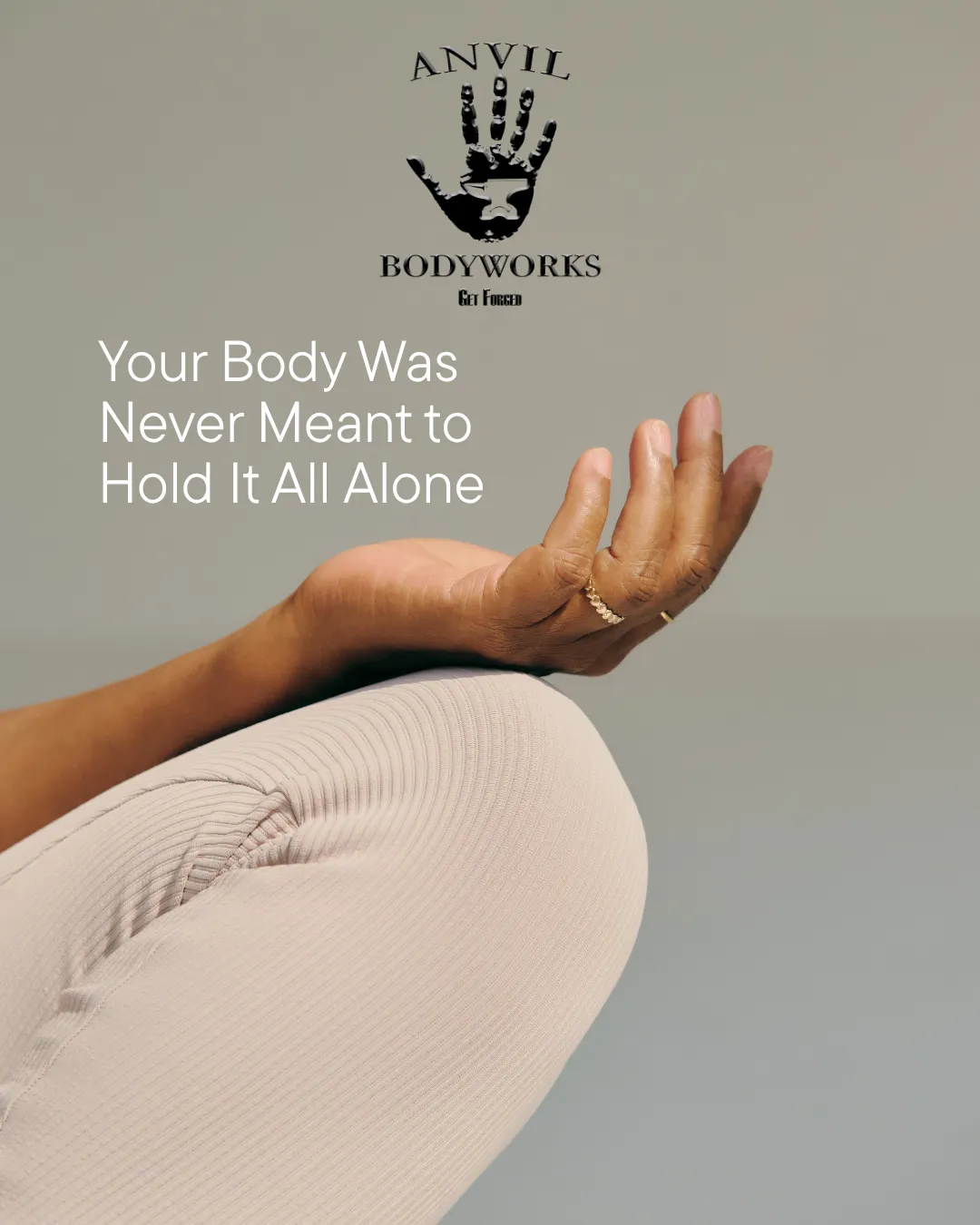
Your Body Was Never Meant to Hold It All Alone
There’s a quiet kind of exhaustion that doesn’t come from doing too much.
It comes from holding too much.
Holding tension.
Holding stress.
Holding responsibility.
Holding everything together… for everyone else.
And after a while, it stops feeling like something you’re doing.
It just feels like who you are.
The Habit of Holding
Most people don’t realize how early this starts.
You learn to:
Push through discomfort
Stay strong under pressure
Keep moving, no matter what
Carry what needs to be carried
And for a while…
It works.
You get things done.
You show up.
You handle what’s in front of you.
But your body is keeping track.
Even when you’re not.
Where It Shows Up
Holding doesn’t stay abstract.
It becomes physical.
You feel it in:
The tightness across your shoulders
The constant tension in your neck
The weight in your lower back
The restriction in your hips
But it’s not just the body.
It shows up as:
Shallow breathing
Restlessness
Trouble relaxing
A constant sense of “on”
You’re functioning.
But you’re not at ease.
You Were Never Meant to Do This Alone
Here’s the part most people don’t hear enough:
Your body was never designed to hold everything by itself.
Not the physical load.
Not the emotional weight.
Not the constant demand of modern life.
Support isn’t a luxury.
It’s a requirement.
And without it…
The body compensates.
Until it can’t.
Why Letting Go Feels So Hard
If holding is what you’ve practiced…
Letting go can feel unfamiliar.
Even uncomfortable.
Because your body has learned:
“Staying tight keeps me in control.”
“Staying guarded keeps me safe.”
“Letting go means something might fall apart.”
So even when you want to relax…
Part of you resists it.
Not because something is wrong.
But because your body doesn’t yet trust that it’s safe.
This Is Where Bodywork Becomes Different
At ANVIL Bodyworks, the goal isn’t to force your body to relax.
It’s to create an environment where it chooses to.
That starts with:
Consent
Communication
Comfort
The Three C’s aren’t just principles.
They’re how trust is built.
And trust is what allows the body to release.
The Power of Safe Touch
There’s something powerful about intentional, grounded touch.
Not rushed.
Not mechanical.
Not routine.
But present.
Attuned.
Responsive.
When touch is applied this way, the body begins to recognize:
“I don’t have to do this alone.”
That recognition changes everything.
What Support Actually Feels Like
Support doesn’t always look dramatic.
Sometimes, it’s subtle.
It’s the moment:
Your shoulders drop without effort
Your breath deepens naturally
Your mind quiets
Your body stops bracing
It’s the shift from holding…
to being held.
And for many people, that’s unfamiliar.
But it’s also what they’ve been needing the most.
Relearning How to Feel Your Body
When you’ve been disconnected for a long time, awareness fades.
You stop noticing:
Where you’re tense
How you’re moving
What your body needs
Bodywork brings that awareness back.
Not in a forceful way.
But in a way that invites you to listen again.
To feel again.
To reconnect.
This Is Not Just Physical Work
At ANVIL, bodywork isn’t separated into categories of physical or emotional.
Because your body doesn’t separate them.
Everything is integrated.
That’s why a session might include:
Deep, targeted muscle work
Slow, fascia-focused release
Nervous system regulation
Breath awareness
Not because it’s a routine.
But because it’s what your body is asking for.
What Happens When You Stop Carrying It Alone
When your body starts to experience support consistently:
You begin to notice changes.
You feel:
Lighter
More mobile
Less reactive to stress
More aware of your limits
More capable of recovery
But more importantly…
You stop feeling like everything is on you.
The Shift Most People Don’t Expect
Clients often come in for pain relief.
And they get it.
But what they don’t expect is this:
They leave feeling different.
Not just physically.
But mentally.
Emotionally.
Grounded.
Because when the body releases tension…
The mind follows.
This Is What Care Actually Looks Like
Care isn’t pushing through until you break.
Care isn’t ignoring discomfort until it demands attention.
Care is:
Listening early
Responding consistently
Giving your body what it needs to function well
It’s not indulgent.
It’s responsible.
You Don’t Have to Earn Relief
This is important.
You don’t need to:
Be in extreme pain
Hit a breaking point
“Deserve” time for yourself
Your body doesn’t operate on that system.
It needs support because it’s human.
Because it’s used every day.
Because it carries more than it should.
The Question That Matters
Not:
“Can I keep going like this?”
But:
“Why have I been trying to do this alone?”
The Invitation
If you’ve been holding more than you should…
If your body feels tight, heavy, or constantly working…
If you’ve been pushing through instead of addressing it…
You don’t have to keep doing that.
There’s another way.
One where your body is supported.
Where tension is addressed.
Where you don’t have to carry everything by yourself.
It’s time to get on the table.