
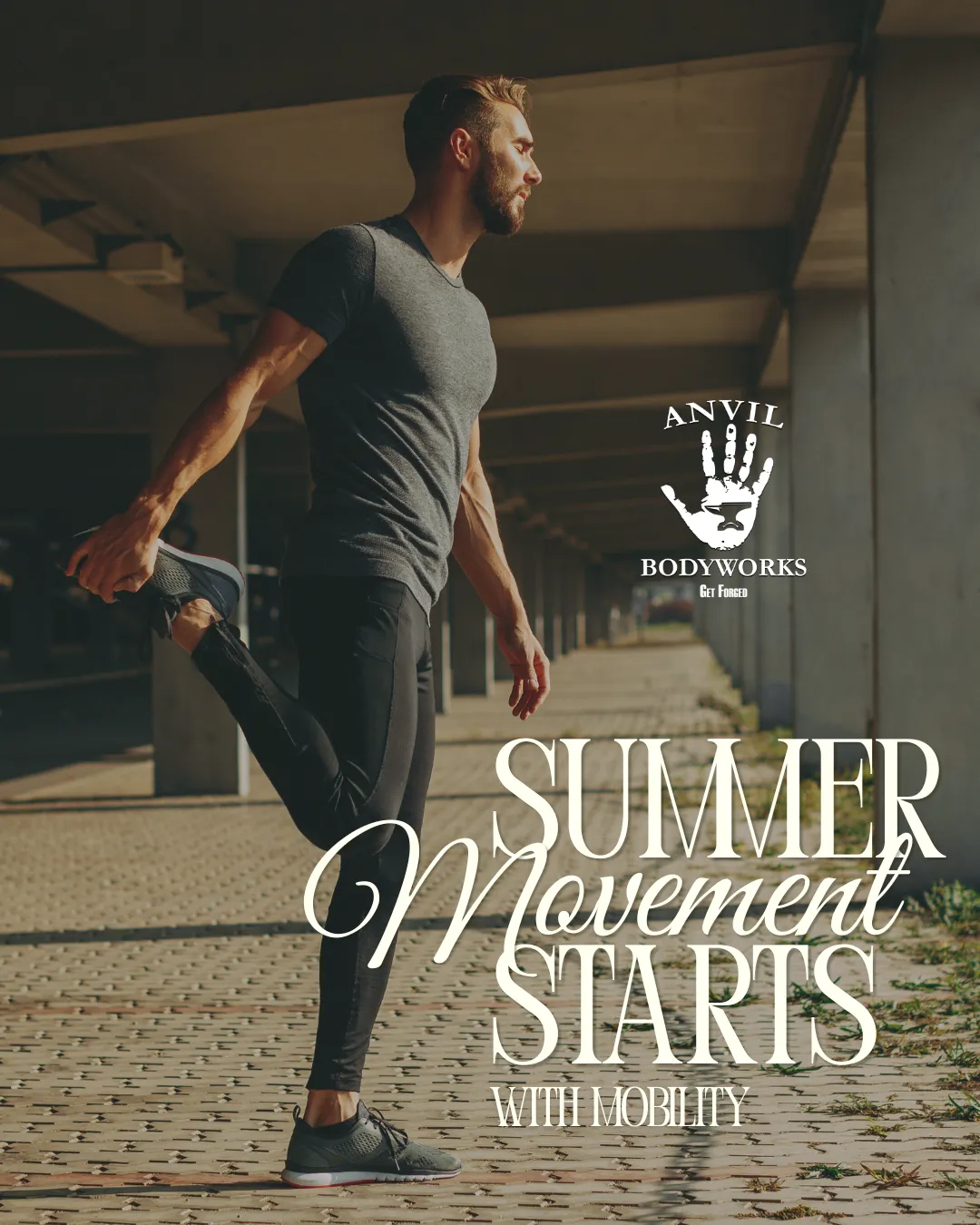
Summer Movement Starts with Mobility: Why Stiffness Isn't Just Part of Getting Older
Summer has a way of reminding us how much we want to move.
The days are longer.
The weather is better.
Vacations are planned.
The trails call our name.
Projects around the house suddenly seem possible.
Kids want to play outside.
Friends invite us on hikes, bike rides, camping trips, and weekend adventures.
After months of colder weather and more time indoors, many people feel excited to become active again.
Then reality shows up.
The knees feel stiff.
The hips don't move like they used to.
The shoulders ache after a day of yard work.
The low back tightens during a road trip.
A simple hike leaves the body feeling more restricted than refreshed.
Many people shrug and say the same thing:
"I guess I'm just getting older."
While aging certainly changes the body, stiffness is not always a normal consequence of getting older.
More often, stiffness is a sign that your body is asking for attention.
At ANVIL Bodyworks, I regularly work with clients who assume discomfort is simply part of aging. What they often discover is that many of the limitations they experience are actually related to mobility restrictions, accumulated tension, poor recovery, repetitive movement patterns, and stress.
The good news?
Many of these issues can improve.
What Mobility Actually Means
Mobility is often confused with flexibility.
While the two are related, they are not the same thing.
Flexibility refers to a muscle's ability to lengthen.
Mobility refers to your ability to move a joint through its full range of motion with control.
In simple terms:
Flexibility is having access to movement.
Mobility is being able to use that movement.
You might have flexible muscles but poor mobility.
You might also have limited flexibility that contributes to poor mobility.
Both matter.
When mobility decreases, everyday activities become harder.
Reaching overhead.
Getting out of the car.
Twisting to grab something.
Squatting down.
Walking uphill.
Lifting groceries.
Playing with grandchildren.
Even small restrictions can have a significant impact on quality of life.
Why Summer Exposes Mobility Problems
During the winter months, many people naturally become less active.
We spend more time indoors.
Work schedules remain demanding.
Screen time increases.
Movement becomes more limited.
The body adapts to whatever demands are placed upon it.
Unfortunately, prolonged sitting and repetitive movement patterns often create restrictions over time.
Then summer arrives.
Suddenly we're asking the body to do more.
A weekend hiking trip.
Hours spent gardening.
A long road trip.
Swimming.
Carrying luggage.
Home improvement projects.
The body is expected to perform at a higher level without much preparation.
This is often when mobility restrictions become obvious.
The issue was there all along.
Summer simply exposed it.
Your Body Adapts to How You Use It
One of the most remarkable things about the human body is its ability to adapt.
Unfortunately, adaptation works both ways.
If you move well, your body adapts positively.
If you move poorly or not enough, your body adapts to that as well.
Consider the average adult.
They may spend:
Eight hours sitting at a desk
One hour driving
Several hours looking down at a phone
Limited time performing full-body movement
Over weeks, months, and years, the body begins accommodating these positions.
The hips tighten.
The chest shortens.
The shoulders round forward.
The upper back stiffens.
The neck becomes restricted.
Eventually these adaptations become normal.
Many people don't realize how much movement they've lost until they attempt an activity they enjoy.
The Hidden Role of Fascia
When discussing mobility, most people think about muscles.
However, muscles are only part of the story.
Another important component is fascia.
Fascia is a connective tissue network that surrounds muscles, bones, nerves, and organs throughout the body.
Think of it as a web connecting everything together.
Healthy fascia allows tissues to glide and move efficiently.
When fascia becomes restricted, movement can feel limited.
You may experience:
Tightness
Pulling sensations
Reduced range of motion
Compensation patterns
Stiffness that stretching alone doesn't resolve
This is one reason why mobility isn't always improved simply by stretching more.
The body functions as an integrated system.
Addressing mobility often requires a broader approach.
Stress Creates Physical Restrictions
One of the most overlooked contributors to mobility limitations is stress.
Many people separate emotional stress from physical movement.
The body does not.
Stress influences:
Breathing patterns
Muscle tension
Posture
Recovery
Movement quality
Think about what happens when you're under pressure.
Your shoulders rise.
Your jaw tightens.
Your breathing becomes shallow.
Your body prepares for action.
When stress becomes chronic, these patterns often become habitual.
The result is not just mental fatigue.
It's physical restriction.
This is why some clients notice improved mobility after addressing tension patterns that initially seemed unrelated to movement.
The nervous system and the musculoskeletal system are deeply connected.
Research on Bodywork and Mobility
Research continues to support the role of therapeutic bodywork in improving movement and recovery.
Studies have found that massage and manual therapy may help:
Improve range of motion
Reduce perceived muscle stiffness
Enhance recovery following activity
Improve circulation
Reduce muscle soreness
Support tissue quality
For active adults, these benefits can be especially valuable.
Mobility is not simply about comfort.
Mobility supports performance.
Whether your goal is hiking a Colorado trail, playing pickleball, lifting weights, working in the yard, or simply moving through daily life with less effort, mobility matters.
The better your body moves, the easier movement becomes.
Movement Is Freedom
One of the greatest gifts mobility provides is freedom.
Freedom to travel comfortably.
Freedom to enjoy recreation.
Freedom to participate in family activities.
Freedom to remain independent.
As people age, maintaining mobility often becomes one of the most important factors influencing overall quality of life.
The ability to move confidently impacts:
Physical health
Emotional wellbeing
Social engagement
Independence
Longevity
Mobility isn't just about exercise.
It's about maintaining access to life.
Why Every Body Is Different
One of the challenges with mobility advice online is that it often assumes everyone's body functions the same way.
In reality, movement restrictions are highly individual.
One person's shoulder pain may originate in the shoulder.
Another person's shoulder pain may begin with limited movement through the upper back.
A tight hamstring may not actually be a hamstring problem.
Low back discomfort may originate in the hips.
Movement patterns tell a story.
That's why customized care matters.
At ANVIL Bodyworks, there is no routine sequence.
No cookie-cutter protocol.
No assumption that every body needs the same thing.
Every session begins with listening.
Observing movement.
Identifying restrictions.
Understanding what your body is communicating.
Only then does the work begin.
The Goal Isn't More Stretching
Many people assume mobility problems require endless stretching.
While stretching can be beneficial, it is often only one piece of the puzzle.
Improving mobility may also involve:
Reducing tissue tension
Improving fascial glide
Supporting nervous system regulation
Enhancing movement awareness
Encouraging healthier movement patterns
The goal isn't to force your body into positions.
The goal is to help your body move more efficiently.
When movement becomes easier, everything else becomes easier too.
Summer Is Meant to Be Enjoyed
Summer should be a season of movement.
A season of exploration.
A season of experiences.
Too many people spend it managing discomfort that they assume is unavoidable.
The truth is that stiffness is often a message, not a sentence.
Your body may simply be asking for attention.
Asking for recovery.
Asking for movement.
Asking for support.
You don't have to wait until pain becomes severe.
You don't have to accept restriction as your new normal.
You don't have to believe that aging automatically means losing access to the activities you love.
Mobility is worth protecting.
Recovery is worth prioritizing.
Movement is worth preserving.
Because movement isn't just exercise.
Movement is freedom.
And freedom allows you to fully participate in the life you've worked so hard to build.
This summer, give your body every opportunity to move well, recover well, and continue carrying you toward the experiences that matter most.
Breathe and Smile.